Tools
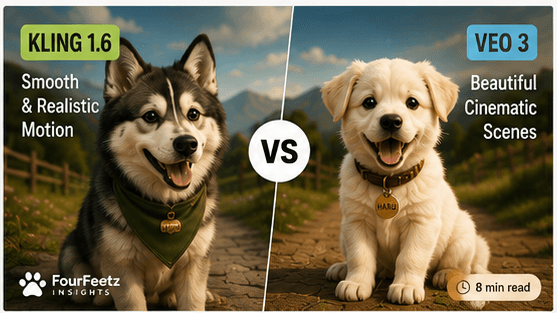
Kling vs Veo
A practical side-by-side comparison of motion quality, character consistency, camera control, prompt following, workflow speed, and overall usefulness for AI filmmaking.
Quick Verdict
Kling felt faster and more responsive for action-oriented tests, while Veo produced the more polished cinematic image when camera control and character stability mattered most.
Motion Quality
Kling
Character Consistency
Veo
Camera Control
Veo
Prompt Following
Kling
Production Speed
Kling
Overall Cinematic Quality
Veo
Why We Compared Them
FourFeetz uses AI video tools as part of a controlled production workflow, not as one-click filmmaking machines. The real question was not which model could make the flashiest clip, but which one produced shots that could survive editing, continuity checks, and repeated character use.
Kling and Veo were compared because both are useful for image-to-video production, short cinematic shots, social video tests, and original character workflows. The test focused on practical usefulness for AI filmmaking rather than brand hype.
Test Setup
The comparison used the same production mindset as the HARU workflow: prepare the first frame carefully, ask for one subject action, define one camera behavior, then judge whether the output could be connected to the next shot.
Review conditions
- Same first-frame image direction for each test whenever possible
- One clear subject action per generation
- One clear camera instruction per test
- Warm daylight or golden-hour lighting language
- Review based on usable shots, not only impressive single outputs
Copyable prompt block
A small original animal character walks along a quiet country road at golden hour. The camera slowly tracks beside the character from a low side-profile angle. Natural body movement, soft warm light, gentle wind in the environment, cinematic 35mm lens, shallow depth of field, calm emotional tone.Walking Test
Walking shots are deceptively difficult because the motion must feel natural while the body shape remains stable. Kling produced energetic movement quickly and followed simple direction well. Veo produced smoother cinematic atmosphere and more stable framing, but sometimes felt slower to iterate.
Kling
Best for fast walking tests, clear movement, and quick variations from the same setup.
Veo
Best for controlled pace, steadier framing, and more refined cinematic softness.
Running Test
Running increased the difficulty for both tools. Kling handled speed and momentum better, which made it useful for energetic tests. Veo kept the image more cinematic but was more sensitive to complex action and needed tighter shot planning.
Close-Up Test
Close-ups revealed the biggest difference in character handling. Veo was stronger at preserving a polished face, soft lighting, and believable camera presence. Kling remained useful, but facial proportions and fine details were more likely to shift when the shot asked for emotional nuance.
Kling
Useful for expressive variations, but detail drift needs careful review.
Veo
Stronger for stable close-ups, mood, and premium cinematic framing.
Camera Movement
Veo had the advantage in camera movement. Slow tracking, gentle push-ins, over-the-shoulder framing, and cinematic depth generally felt more physically plausible. Kling was still useful for direct movement prompts, but the camera language needed to stay simple.
The best results came from camera instructions that could exist in the real world: slow dolly in, fixed side profile, gentle tracking shot, shallow depth of field, and golden-hour lighting.
Prompt Following
Kling was slightly stronger at following direct action instructions. If the prompt asked for a clear movement, Kling often responded quickly and produced usable variations. Veo followed cinematic direction well, but complex prompt details sometimes became softer or more interpretive.
For both tools, short prompts outperformed overloaded prompts. A good first frame plus one clear movement direction was more reliable than a long paragraph full of competing instructions.
Workflow Speed
Kling had the advantage for speed. It was useful when testing multiple motion ideas, comparing prompt phrasing, or producing quick options for short-form video. Veo felt slower as a workflow tool but often produced outputs that needed less visual polishing when the shot succeeded.
Kling
Faster for iteration, prompt testing, and movement exploration.
Veo
Slower, but often stronger for final cinematic candidate shots.
What Worked Best
Kling for Active Motion
Kling felt strongest when the scene needed energy, speed, and direct prompt response.
Veo for Cinematic Framing
Veo produced the most polished camera behavior and natural cinematic atmosphere.
Simple Actions
Both tools performed better when the shot had one primary subject action.
Prepared References
The quality of the starting image mattered more than adding longer prompt text.
What Did Not Work Well
Too Many Instructions
Layering several actions, camera moves, and style requests reduced control.
Fast Anatomy Changes
Complex running, jumping, and object interaction still needed repeated attempts.
Long Continuity Assumptions
Neither tool replaced manual planning for multi-shot character continuity.
One Perfect Output
The best result usually came from comparing several short generations.
Final Scores
Kling
Motion Quality
4.7/5
Character Consistency
4.2/5
Camera Control
4.1/5
Prompt Following
4.6/5
Workflow Speed
4.7/5
Cinematic Quality
4.4/5
Overall
4.5/5
Veo
Motion Quality
4.5/5
Character Consistency
4.8/5
Camera Control
4.9/5
Prompt Following
4.4/5
Workflow Speed
4.0/5
Cinematic Quality
4.9/5
Overall
4.6/5
Verdict
Kling is the better choice when production speed, prompt responsiveness, and active motion are the priority. It fits early exploration, movement tests, and short clips where iteration speed matters.
Veo is the stronger choice when the shot needs premium cinematic atmosphere, stable close-ups, and more refined camera behavior. For FourFeetz-style AI filmmaking, the best workflow is not choosing one tool forever. It is choosing the tool that fits the shot.
Related Articles
Continue Exploring
Runway Gen-4 Review
A practical review of character consistency, motion quality, and camera control.
Open
A Repeatable AI Video Workflow
A production pipeline for planning, generating, editing, and publishing AI video.
Open
Writing Better Image-to-Video Prompts
Prompt structure for movement, lighting, environment, and continuity.
Open
Camera Movement Guide for AI Filmmakers
A guide to tracking shots, push-ins, orbits, pans, tilts, and cinematic AI camera movement.
Open